Philip Adler
World War ZPhilip Adler is a German military officer and survivor whose testimony gives the collapse of Hamburg its most concentrated moral force. Encountered in Armagh, Ireland, during his first journey outside Germany since the end of the war, he recalls a city overrun by Zombies, a garrison ordered to retreat without warning its refugees, and the decision that left him unable to regard obedience as an excuse. His account is not a story of clean heroism: it is an anatomy of duty, guilt, and the permanent weight of choices made under impossible conditions.
Identity and Introduction
Philip Adler appears as a German speaker whose connection to the war is both personal and institutional. He is visiting the pope’s wartime refuge because his Bavarian wife has made a pilgrimage to Saint Patrick’s Cathedral, and the meeting with the interviewer occurs by accident in a hotel bar. This domestic detail places him between ordinary postwar life and the military catastrophe he carries with him. He is away from Germany for the first time since the war’s end, suggesting that travel is not merely leisure but a tentative movement out of the territory of memory.
Adler’s national identity is central to the way he understands command. He describes himself as a West German and distinguishes that background from the moral culture he associates with East Germany. In his account, West Germans were raised to bear responsibility for the crimes of the past and to regard conscience as a first duty even when wearing a uniform. That inherited historical burden becomes the standard against which he measures his conduct in Hamburg. He does not present conscience as an abstract ideal; he treats it as a discipline that must survive when every official order points toward expediency.
Hamburg and the Collapse of Command
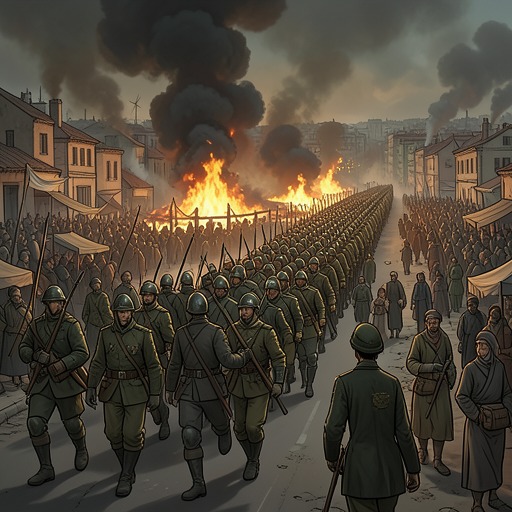
Hamburg, as Adler remembers it, was heavily infested. Zombies filled the streets and buildings and poured from the Neuer Elbtunnel, moving through gaps in civilian barricades. Refugees had crowded into the city from as far away as Saxony, hoping to escape by sea, but the ships had already departed and the port had become a trap. More than a thousand civilians were stranded at the Reynolds Aluminiumwerk and at least three times as many at the Eurokai terminal, without food or clean water, while the dead swarmed outside and infection threatened the living within.
The harbor was choked with moving corpses. Adler’s forces used antiriot water cannons to blast Zombies into the water, conserving ammunition while clearing the streets, until the pressure in the hydrants failed. The danger was not limited to direct contact. His commanding officer died after a bullet passed through a Zombie’s head and carried diseased brain tissue into the colonel’s shoulder. Adler inherited sector command and made his first official act the killing of the officer who had been placed in charge before him. The incident captures the war’s grotesque chain of causation: even a successful shot could become a vector of death.
Adler established his command post in the Renaissance Hotel, chosen for its fields of fire and its capacity to shelter his unit and several hundred refugees. With roads blocked and trains inoperative, his men began converting comparable buildings into fortified shelters. He believed help would come and tried to sequester as many civilians as possible. That effort was abruptly contradicted by orders from above: the garrison was to withdraw to Schleswig-Holstein and was forbidden not only to move the civilians but also to tell them that the soldiers were leaving.
The Withdrawal and the Moral Choice
Adler repeatedly sought confirmation because the order seemed too irrational to be genuine. General Lang, commander of the entire Northern Front, finally confirmed that the withdrawal was deliberate and demanded that Adler rally what remained of the Hamburg Garrison and move north immediately. The order created a conflict more unbearable to Adler than the rising dead. He could accept the physical impossibility of the outbreak, but he could not accept an instruction that would indirectly produce mass murder.
Lang threatened Adler and his men with treason charges and prosecution with “Russian efficiency” if they refused. Adler understood that resistance would endanger not only himself but also the eighteen- and nineteen-year-old soldiers who were exhausted, frightened, and still fighting for their lives. He therefore gave the order to withdraw. The decision is presented neither as simple cowardice nor as uncomplicated courage. Adler acts to protect his men from punishment, yet that protection also makes him the instrument of abandoning the civilians he had organized his command to defend.
The refugees recognized the betrayal immediately. They shouted from the buildings, demanding to know where the soldiers were going and calling them cowards. Adler tried to promise that the troops would return the next day with more men, but the civilians did not believe him. One woman accused him of letting her baby die. As the column departed, some refugees seized the armored personnel carriers and tried to force their way through the hatches. The soldiers knocked them off and sealed themselves inside while civilians threw lamps and furniture down at the vehicles; one soldier was struck by a bucket of human waste, and a bullet rang against Adler’s Marder.
The retreat was protected by a Rapid Reaction Stabilization Unit that had already been badly mauled and had been classified as expendable. Its orders were to hold to the end so that too many Zombies or refugees would not follow the withdrawing force. Adler did not know the unit’s status at the time, but the later knowledge deepens his sense that the withdrawal was not an isolated emergency decision. It was part of a system that converted soldiers and civilians alike into disposable components of a larger plan.
The Prochnow Plan and Responsibility
Adler’s later understanding of the Prochnow Plan changes the emotional meaning of Hamburg. He does not become more sympathetic toward the authorities after learning the plan’s details; he hates them more. The plan explains why the retreat had been ordered and why the garrison and civilians were treated as sacrifices, but explanation does not absolve the people who carried it out. For Adler, the central failure lies in the attempt to transfer responsibility upward, onto the plan’s architect or the commanding officer who issued the order.
He imagines the war’s future as a steep and dangerous mountain road, with every participant dragging behind a boulder made from what he or she has done. The comparison identifies his lasting condition: survival has not released him from the decision at Hamburg. He believes the plan’s architect understood that the coming war would require men like Adler, yet abandoned them because he could not bear the moral weight of the road ahead. In Adler’s judgment, that retreat from responsibility mirrors the garrison’s own abandonment of the refugees.
This is why Adler’s testimony resists the comforting language of following orders. In another military episode, soldiers are forced into groups of ten and made to vote on which member will be executed, then kill their own comrades with stones. The arrangement binds them through shared guilt as well as fear and gives them the “freedom” to claim that someone else ordered their actions. Adler’s Hamburg experience belongs to the same moral universe. Authority can compel obedience, but it cannot make the resulting act belong to nobody.
Political Order After the War
Adler’s recollections also illuminate the wider political logic of the crisis. The authorities knowingly allowed Phalanx to function as a placebo because the truth about a plague that reanimated the dead might have caused protest, riots, property destruction, and legislative paralysis. The deception was defended as a way to preserve political capital during an election year and to keep the public attached to promises of peace and prosperity. Adler’s military story therefore sits alongside a broader portrait of governments managing fear through concealment and controlled belief.
The postwar American administration he describes likewise turns extraordinary punishment into a practical instrument of reconstruction. Placing thieves and looters in stocks, whipping them in public, and displaying signs that identified their crimes seemed barbaric until weighed against the cost of prisons and guards. Public humiliation was treated as a deterrent in a society where collective cooperation had become essential. Adler’s account of command helps explain the danger in that logic: once survival is made the measure of every action, conscience can be recast as an obstacle, while coercion presents itself as efficiency.
The same tension appears in the treatment of refugees in Cuba under the Quarantine Resettlement Program. Five million boat people, nearly half of Cuba’s indigenous population, were placed under government jurisdiction. Adler’s wider testimony records that the resettlement centers were not formally comparable to political prison camps, yet their residents initially worked twelve- to fourteen-hour days as field hands on former state-run sugar plantations, while guards beat them and threatened them with Zombies. Rumors of “zombie pits,” deliberately spread by the General Intelligence Directorate, show how fear can be administered even when the threatened punishment is fictitious.
Narrative Role and Enduring Meaning
Philip Adler’s narrative role is that of the witness who refuses to let strategy erase individual responsibility. His account supplies tactical particulars—the tunnel, the hotel, the hydrants, the Marder, the abandoned terminals—but each detail opens into an ethical question. The city’s physical collapse is inseparable from the collapse of the moral assurances that normally make military obedience bearable.
His testimony also exposes the limits of a conventional survivor’s journey. Adler crosses the threshold into catastrophe, survives the retreat, and returns to a world rebuilding itself, but he does not receive a consoling reward or a clean reintegration. The war’s end permits travel, marriage, and conversation in a hotel bar; it does not dissolve the dead civilians, the abandoned buildings, or the order he obeyed. His “return” is therefore marked by unresolved knowledge rather than triumph.
The significance of Philip Adler lies precisely in that refusal of absolution. He recognizes that plans, generals, political necessities, and emergency laws shape human action, but he insists that none of them can carry the entire burden afterward. Hamburg remains the decisive scene because it forces the soldier to choose between obedience and conscience, then makes him live with the fact that every available choice injures someone. In a book built from testimony, Adler’s voice turns survival into an accusation: the dead are not the only casualties of the Zombie War; responsibility survives as well.